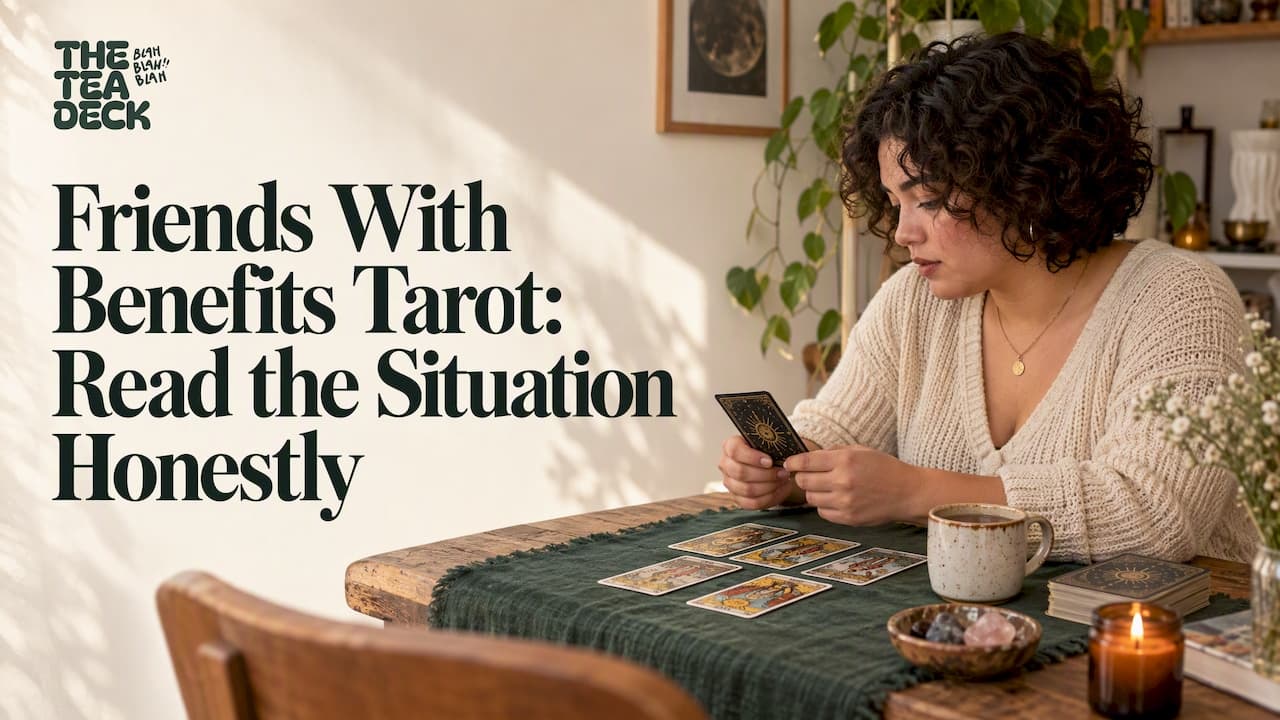
A friends with benefits tarot reading can help you name what you feel, what you want and what you're avoiding saying out loud. It can't tell you what the other person secretly feels, and it can't promise the situation turns into a relationship. Use the cards as a mirror, then take what you see into a real conversation.
Below you'll find the questions that work, a six-card spread you can pull tonight, how to read the "romantic" cards without spiraling, and when it makes sense to get a second pair of eyes.
TL;DR
- Ask tarot questions about you: your hopes, your boundaries, your next step. Skip "Are they secretly in love with me?"
- A six-card spread (attraction, emotion, unsaid, hopes, risk, next step) keeps one dramatic card from becoming a verdict.
- Cards like the Lovers or Two of Cups are prompts, not proof of commitment.
- Research on FWBs says early communication and matched expectations matter more than any card.
- If you want an outside read on your exact situation, we do private, anonymous readings at The Tea Deck.
Table of Contents
- What "friends with benefits" actually means
- Why people pull cards on an FWB situation
- What tarot can and can't do here
- Questions worth asking (and one to skip)
- A six-card friends with benefits spread
- Cards people hope to see (and how to read them)
- What the research says happens to FWBs
- From cards to a real conversation
- Our take: clarity beats prediction
- Want a second read on your situation?
- When to put the cards down
- FAQ
- Sources
What "friends with benefits" actually means
The label sounds simple, and it isn't. Friends with benefits describes a friendship that includes recurring physical intimacy, without necessarily being a romantic commitment. It's usually more ongoing than a one-off hookup, and it may or may not turn into romance.
Notice what the label does not tell you: whether it's exclusive, whether anyone has feelings, or whether there's a future. Two people can both say "we're FWB" and mean completely different things. That gap is exactly where most of the confusion (and most tarot questions) come from.
Why people pull cards on an FWB situation
Usually it's one of these moments:
- They text you at 1 a.m. but disappear on weekends.
- You've started to want more and don't know if you're allowed to say it.
- They were weirdly sweet last week and cold this week.
- You're not sure if you want it to continue at all.
In all of them, you're holding a pile of mixed signals and you want somewhere to put them. Tarot is good at that. Laying out cards gives you a structure for sorting your thoughts, which is different from getting an answer from the universe.
What tarot can and can't do here
Be clear on this before you shuffle. Tarot cannot reliably tell you whether another person is catching feelings, and it can't predict a definite outcome. Clinical commentary on tarot and psychic practices notes there's no scientific grounding for mind-reading or future prediction. Phil Lane, a licensed clinical social worker, writes in Psychology Today about the risks of leaning too hard on psychics and similar tools to cope with anxiety.
Psych Central's review says tarot may ease worry tied to uncertainty, but that research on its positive effects is limited. So the safest frame is reflection and perspective, not diagnosis and not certainty.
A.E. Waite, whose deck and text shaped the modern tarot, wrote that the true Tarot is symbolism. Symbols get their meaning from your question, the cards around them and the facts of your real life. That's why "the Lovers = they love you" is a trap.
Questions worth asking (and one to skip)
The best questions give the power back to you. Try these:
- What is the emotional undercurrent here?
- What am I hoping this becomes?
- What boundary needs attention?
- What happens if nothing changes?
- What is my healthiest next step?
These come from a decade of FWB research-informed approach to readings. The one to skip: "Are they secretly in love with me?" Treat it as a mind-reading test and you'll just collect cards that match whatever you already hope. If the question does tempt you, rewrite it: "What behavior from them have I actually seen, and what conversation could I have about it?"
A six-card friends with benefits spread
Shuffle while thinking about the situation, not about the person's mind. Then lay out six cards in two rows of three.
| Position | What it shows | Question to hold |
|---|---|---|
| 1. Attraction | The physical pull and what it's doing for both of you | What's the spark made of? |
| 2. Emotional undercurrent | What's under the surface, mainly on your side | What am I feeling that I'm not saying? |
| 3. What's unsaid | Unspoken expectations or rules | What haven't we talked about? |
| 4. Your hopes | What you want this to become | What do I actually want? |
| 5. Risk | What staying in the current pattern could cost | What happens if nothing changes? |
| 6. Next step | Your healthiest move | What can I do this week? |
Splitting the reading into these slots stops one dramatic card from turning into a verdict about the other person. Position 6 matters most: it should always end in an action you control.
How to read the result
- Write the card names and your first gut reaction before you look anything up.
- Read the row, not the card. Cards 1 to 3 describe the current dynamic; cards 4 to 6 describe you and your options.
- Look for a pattern. Lots of cups points to feelings, swords to thinking and communication, pentacles to practical stuff, wands to energy and drive. Treat this as a loose lens, not a rule.
- Turn card 6 into a sentence you could say out loud or a boundary you could set.
Cards people hope to see (and how to read them)
Meanings vary by deck, school, question and whether you read reversals. There's no single binding meaning for a card. Still, a few come up constantly in FWB readings.
- Two of Cups: traditionally linked to friendship, affinity, union and mutual connection. In an FWB spread it can show real chemistry. It doesn't say the chemistry is romantic or mutual in the same way.
- Three of Cups: commonly read as friendship, celebration and social joy. That can be the fun, easygoing side of the arrangement. It can also hint that you two work best as friends.
- The Lovers: often about choice and alignment as much as romance. Ask what choice is on the table.
- Wheel of Fortune: associated with luck, cycles and changing circumstances. In this context it's a reminder that FWB setups rarely stay still.
- Ten of Cups: emotional fulfilment. It might reflect what you're hoping for rather than what's currently happening, especially in the hopes position.
For the card meanings, see the Waite text and a Rider-Waite card list for the traditional wording. Treat them as starting points.
A passionate card is not a commitment
Say you pull the Lovers in the "emotional undercurrent" spot. It feels like a yes. Before you celebrate, check it against behavior: do they make plans in advance? Do they show up when it's not convenient? Do they talk about next month? If not, the card is describing intensity, not intention.

What the research says happens to FWBs
Tarot is a reflection tool. Data is a reality check. In a one-year study summarized by psychologist Justin Lehmiller in Psychology Today, of 192 people:
| After about one year | Share |
|---|---|
| Still FWBs | 26% |
| Became romantic partners | 15% |
| Went back to being friends | 28% |
| No relationship at all | 31% |
The sample was mostly female-identified (70%), white (74%) and heterosexual (72%), with an average age of 30, and Lehmiller cautions the findings aren't representative of all FWBs. Still, the takeaway is useful: most arrangements change or end within a year, and it's not a doom story, just a sign that "staying exactly like this forever" is the least common path.
Two other findings matter for your spread. People focused on preserving the friendship were largely successful, while those hoping for true love mostly weren't. And the most commonly reported reasons for arrangements failing were insufficient early communication and wanting different things.
There's a hopeful counterpoint too. A study reported by the Vancouver Sun looked at 764 people in exclusive relationships. About 20% said theirs began as FWB, and after four months those couples were no more likely to have split than others. The report notes possible self-selection and stresses that transitions work best when both people want them. So it's not a promise that your situation will become a relationship. It just shows that starting casual doesn't doom anything.

From cards to a real conversation
This is where a reading earns its keep. Your six cards should leave you with two or three things to say. The research points to early ground-rule communication as a main difference between arrangements that continue in some form and those that vanish. Topics worth covering:
- Exclusivity: are you both seeing other people?
- Safer sex: what testing and protection do you both expect?
- Sleepovers and aftercare: is staying over okay, or off the table?
- Public behavior: how do you act around mutual friends?
- Communication frequency: what counts as normal texting?
- If feelings show up: what's the plan if one of you starts wanting more?
You can open with something low-pressure: "I've been thinking about what we're doing and I'd like us to be on the same page. Can we talk about it?" Then say what you want, not what you suspect they want.
A reality check from the research: wanting it to become romantic is not the same as it moving that way. So phrase your tarot question around your own choices. Continue, pause, define or end are all valid outcomes.
Our take: clarity beats prediction
We read for people stuck in exactly this kind of gray area: mixed signals, vague labels, a situation that feels fun and confusing in equal parts. Here's how we look at friends with benefits readings.
First, we think the best reading is short and direct. A wall of mystical text doesn't help when you need to decide whether to reply to a text. Second, we think privacy matters. Nobody should have to sit across from a stranger in a room and explain their situationship. That's why our readings are private, concise and delivered digitally, with room for you to ask a specific question.
Third, and this is the part we care about most: we don't treat a card as a verdict on someone else's heart. A good reading points at what you can see, what you want and what you can do next. If a reading leaves you feeling calmer and clearer, great. If you notice you're pulling card after card hoping for a different answer, that's a signal to step back and talk to the person, or to a friend, or a therapist.
That's the whole idea behind how we work. Pull cards for perspective, then go live your actual life.
— THE
Want a second read on your situation?
If you'd rather not DIY your spread, you can ask us. At The Tea Deck we offer private tarot guidance for relationship questions, mixed signals and personal dilemmas. You ask a specific question, get a concise interpretation delivered digitally and skip the awkward in-person appointment. You can see how it works on our process page.
When to put the cards down
Tarot should add clarity, not anxiety. Pause and talk to someone if any of these sound familiar:
- You're asking the same question again and again, hoping the answer changes.
- A reading is making you feel more anxious, not less.
- You're spending money you can't spare on reassurance.
- You're using a reading in place of a direct conversation.
Phil Lane recommends noticing whether the practice truly helps or fuels compulsive reassurance-seeking. Sexual-health decisions, consent and ground rules also belong in a conversation with your partner and, if needed, a clinician such as a doctor or sexual health clinic. If you're feeling overwhelmed or unsafe, reach out to a licensed therapist, or in the US call or text 988 for the Suicide and Crisis Lifeline.
FAQ
What does "friends with benefits" mean?
It's a friendship that includes recurring physical intimacy without necessarily being a romantic commitment. It's typically more ongoing than a hookup and may or may not become a relationship. The label alone doesn't say whether it's exclusive or whether anyone has feelings.
Which tarot card represents friendship?
The Three of Cups is commonly read as friendship, celebration and social joy, and the Two of Cups is linked to friendship, affinity and mutual connection. Meanings vary by deck and context, so read them alongside your question and the neighboring cards.
Which tarot card is associated with luck?
The Wheel of Fortune is traditionally tied to luck, fortune and cycles. It's more about changing circumstances than a guaranteed lucky outcome.
How do you pick tarot cards for someone else?
You can focus on the situation between you and pull cards about your side of it. Skip trying to read their private thoughts, since tarot can't verify what another person feels. If you want their perspective, ask them directly.
Sources
- Friends with benefits, Wikipedia
- What Happens to Friends With Benefits Over Time?, Psychology Today
- What I Learned From a Decade of Studying Friends With Benefits, Sex and Psychology
- Psychics and Other Unscientific Ways of Coping with Anxiety, Psychology Today
- Using Tarot Cards for Health Readings, Psych Central
- The Pictorial Key to the Tarot, A.E. Waite
- Tarot Cards List from the original Rider-Waite Tarot Deck
- Friends with benefits can evolve into long-term pairings, Vancouver Sun