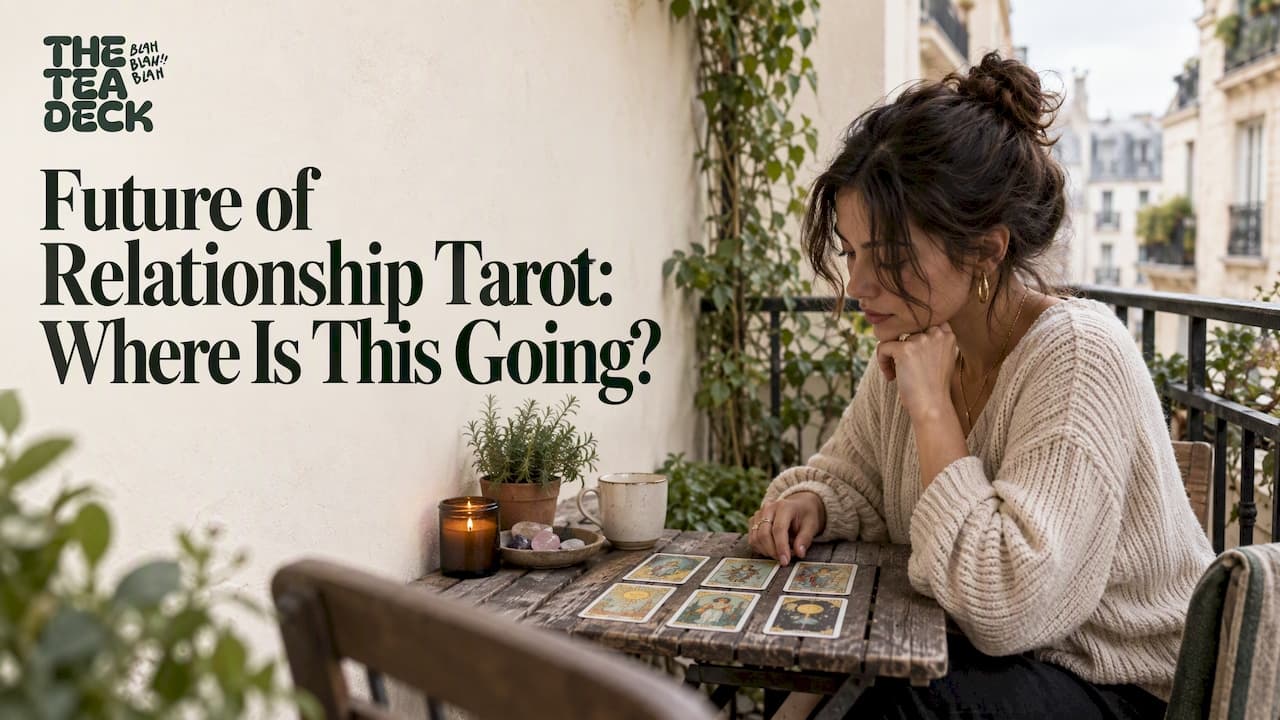
Tarot can't tell you what another person will decide, but it can show you the shape of what's happening between you, where it's likely to go if nothing changes, and what your next move could be. That's the honest version of a future-of-the-relationship reading. Below you'll find how to ask the question so the cards answer something useful, a simple spread you can try tonight, and how to read what comes up when the other person is giving you mixed signals.
TL;DR
- A relationship future reading works best as a snapshot plus a direction, not a verdict on "will we end up together?"
- Split your question in two: what the other person may want, and whether this is meeting your needs. Only the second one is fully in your hands.
- A six-position spread (current status, near future, growth, communication, challenges, path forward) gives you concise, usable guidance.
- Tarot is reflection and decision support, not therapy or a guarantee. Be wary of any reading that scares you into acting.
- If you'd rather not decode cards alone, a private written reading gives you a straight answer to a specific question.
Table of Contents
- What a "future" reading really means
- Before you pull a card: fix the question
- A six-card future spread you can try tonight
- Reading mixed signals specifically
- What tarot can't do (and why that matters)
- Our take: clarity beats prediction
- When a private reading makes more sense than a DIY spread
- Turning a reading into action
- FAQ
- Sources
What a "future" reading really means
When people search for where this is going, they usually aren't asking about fate. They're asking: is this worth my energy? Should I wait, say something, or walk away? The cards are a prompt for that conversation with yourself.
One guide on tarot and love, from Writual Planner, frames tarot as more than fortune-telling: a way to tap into intuition and explore your emotions. Another reader community makes the same point about the "where is this connection going?" question: it is almost always more about your own readiness than about the other person's choices.
That's not a letdown. It's the useful part. A reading that tells you "he'll text you Friday" gives you nothing to do. A reading that tells you the connection is warm but stuck, and that the missing ingredient is a direct conversation, gives you a next step.

Why the spread changes the answer
The layout you pick decides which questions get asked. In a 2023 scholarly analysis, Jesse R. Erickson explains that changing the spread changes the interpretive structure, tying card imagery to your sense of time and inner psychology. In practice: a one-card pull answers "what's the vibe?" while a six-card layout can ask about communication, obstacles and direction separately. Same deck, very different clarity.

Before you pull a card: fix the question
Most relationship readings go sideways at the question. "Does he love me?" and "Will we be together?" put all the power in someone else's hands and invite vague, anxious answers. Try these upgrades instead.
| Instead of | Try |
|---|---|
| Will we end up together? | What is the current dynamic between us, and what would help it move forward? |
| Does she like me? | What is she showing me through her actions, and what do I need to ask her directly? |
| Will he come back? | What do I need to understand about this ending before deciding what I want? |
| Is this the one? | What is this relationship teaching me, and is it meeting my needs? |
The pattern is simple. A good prompt identifies the current dynamic, the near-term opportunity or challenge, what communication is needed, and the path forward. This is the approach the Writual guide recommends for mixed signals, because it turns uncertainty into decisions you can actually make.
Split the question in two
The Abundance Arcana piece offers a distinction we find genuinely helpful: separate what the other person may want from whether the relationship meets your needs. The first stays ambiguous, because you can't see inside someone's head. The second is answerable through your own boundaries and observations, even when the other person is a maze.
So write down two lines before you shuffle:
- What might they be feeling or wanting? (Expect fuzzy answers.)
- What do I need from this, and am I getting it? (Expect sharper ones.)
If you notice you're hoping for one particular card, that's information too. Ask yourself which outcome you're hoping to see confirmed and which one you're hoping to be spared. That tells you more about your own stakes than any card will.
A six-card future spread you can try tonight
A compact layout is enough for most situations. A six-prompt future-of-the-relationship format covers current status, near future, potential growth, communication and connection, challenges to overcome and the path forward. It's a good fit when you want concise guidance rather than an elaborate forecast.
Lay out six cards in two rows of three, left to right.
- Where you are now. The honest current status. Not the story you tell your friends, the real one.
- The near future. What's likely to show up in the next few weeks if the pattern continues.
- Potential for growth. What could develop if both people lean in.
- Communication and connection. How you're actually talking, and what's going unsaid.
- Challenges. The thing in the way. Sometimes it's the other person, sometimes timing, sometimes your own avoidance.
- The path forward. Your next move. This is the card to screenshot.
A simpler option exists too. A classic three-card love layout asks about the current state of the relationship, the dynamics in play and a looming future, essentially "where is this relationship going?" The "Where Are We Going?" spread on Tarot in Love is built around that exact question, which its author says is one of the most common she hears from clients.
How to read the cards without spiraling
- Read positions, not just cards. The same card means different things in "challenge" and in "growth."
- Look for the story across all six. Does card 4 explain card 5? Often the communication card and the challenge card are two halves of one problem.
- Treat the future cards as conditional. They describe where the current pattern leads. Change the pattern and the outlook shifts.
- Write your read before you look anything up. Your first instinct is the data. Meanings are the reference.
- Don't pull again and again. If you redraw until you get a happy answer, you're not asking, you're bargaining.
Reading mixed signals specifically
Mixed signals are the most common reason people ask tarot about the future. One day they're all in, the next day you're on read. Cards can help, but only if you use them to look at the pattern rather than predict the person.
Here is how the six positions translate for a situationship:
- Current status: Are you describing a relationship, or a series of nice moments? Cards about illusions, hesitation or imbalance often point to a gap between what's said and what's done.
- Near future: Is there an actual opening, like a plan, a conversation, a decision, or only more of the same?
- Communication: This position is usually the most revealing for mixed signals. If it's cloudy, the fix is rarely another card. It's a clear question asked out loud.
- Path forward: Pay attention to whether it points to you acting (asking, setting a boundary, stepping back) or to waiting. A reading that tells you to wait indefinitely should make you suspicious of your own question.
A practical tip: after the reading, convert the path card into one sentence you can act on. "I'll tell them I want something exclusive and see how they respond" is a plan. "Maybe things will work out" isn't.
What tarot can't do (and why that matters)
A fair reading respects its limits. A discussion in a tarot forum puts it bluntly: tarot can't predict the future so much as reflect your state of mind about the question. We'd say the same, with one caveat: that reflection can be valuable, especially when you're too close to the situation to see it.
There's also a research angle. A 2026 qualitative study of three psychology students found participants used tarot around romantic issues and personal dilemmas for reflection, decision support, validation and emotional reassurance. With only three participants it describes an experience rather than proving effectiveness, but it matches what many people tell us: the cards help them put words to what they already half-know.
On the professional side, the College of Psychology of Entre Ríos states that tarot is not a scientifically validated psychological technique and shouldn't be presented as psychological treatment. We agree. If you're dealing with abuse, controlling behavior, a crisis, or anxiety that's taking over your days, talk to a licensed therapist or a counselor, or contact a domestic violence hotline if you're unsafe. A card is not the right tool for that moment.
Signs of a responsible reading
The China Tarot Association's 2025 trial ethics code, though specific to its own jurisdiction, offers useful benchmarks for any paid reading. It emphasizes informed consent, confidentiality, respect for autonomy and transparent pricing, and says no fear-based claims and no replacing medical, psychological, legal or financial professionals. Translate that into a checklist for yourself:
- You know what you're buying and what it costs before you pay.
- Your question and your story stay private.
- The reader never tells you that something terrible will happen unless you pay more.
- You're encouraged to make your own call, not handed one.
- Nobody claims the reading replaces a doctor, lawyer or therapist.
Our take: clarity beats prediction
We built The Tea Deck around one observation: most people don't need a mystical forecast, they need someone to say the quiet part clearly. When a reading lands, it's rarely because a card "knew" something. It's because the layout asked a question you'd been avoiding.
That's why we keep our readings concise and specific. You bring the situation and the question, and you get a direct interpretation of feelings, intentions and likely direction, not a ten-page essay and not a vague horoscope. We also think privacy matters more than people admit. Asking about a crush, an ex or a friend-with-benefits who keeps going cold isn't something everyone wants to do across a table from a stranger. Doing it in writing, on your own time, removes that discomfort.
We also hold a firm line: a reading is reflection and decision support. We don't diagnose, we don't promise outcomes, and we don't use fear to keep you coming back. If a reading ever sounds like it's pushing you toward panic, it isn't doing its job. The best result is that you close the tab knowing what you want to say, ask or stop tolerating.
— THE
When a private reading makes more sense than a DIY spread
Self-pulling is great for building the habit of reflection. It has one weak spot: you already know what you hope the answer is. That bias seeps into every card you interpret. Even experienced readers tend to ask someone else when the stakes are personal.
A private reading can help when:
- You're too emotionally invested to read objectively.
- You've pulled the same cards three times and can't decide what they mean.
- You have one specific question, like "Should I text first or let it be?", and want a direct answer.
- You don't want to explain your situation face to face.
If that sounds like you, Private tarot guidance from The Tea Deck lets you ask your question and get a concise, private interpretation, with no appointment or awkward sit-down. You can see how it works on the process page, and if you're more interested in building your own reading habit, the Be Your Own Cup page is worth a look.
Turning a reading into action
Cards don't change anything until you do. A useful way to close any reading, yours or ours, is a three-step debrief.
- Name the pattern. One sentence: "We're warm in private and vague in public."
- Name your need. One sentence: "I want clarity about whether this is exclusive."
- Name one action. Within a week: ask the question, set the boundary, or take a step back from checking their story views.
Then watch what happens. How someone responds to a clear, kind, direct request tells you more about the future of the relationship than any spread. If they meet you, great. If they dodge, that's your answer to question two: this isn't meeting your needs right now.
A quick worked example
Say you've been seeing someone for two months. They text daily for a week, then vanish for four days, then act like nothing happened. You pull six cards and get a mix: something warm in the current position, something unsettled in the near future, a hesitant card for communication, a heavy one for the challenge.
You don't read that as "they're going to ghost me." You read it as: the connection has real warmth, the communication is the weak point, and the obstacle looks like avoidance. Your path card shows a plain, honest conversation. So your action is to say, "I like you, and the on-and-off thing is confusing for me. What are you looking for?" You aren't predicting. You're gathering information.
FAQ
Can tarot really predict the future of a relationship?
Not reliably, and anyone who promises certainty is overselling. A relationship's future depends on two people's choices, which can change. What tarot can do is reflect the current dynamic and surface options so you can decide your own next move.
Which spread is best for "where is this going?"
For a quick check, a three-card layout covering the present, the dynamics and the likely direction works well. For more detail, especially with mixed signals, a six-card spread covering current status, near future, growth, communication, challenges and path forward gives you more to act on.
How often should I ask about the same relationship?
Give it time. Asking the same question daily tends to feed anxiety, not clarity. Waiting until something has changed, such as a conversation, a new development or a few weeks passing, gives the reading something new to work with.
Is a private tarot reading anonymous?
With a written, online reading, you share only what you choose to include in your question, and you never have to sit across from anyone. Check any provider's privacy and pricing information before paying, and share only what you're comfortable with.
Should I make a big decision based on a tarot reading?
Use it as one input, not the deciding vote. For major decisions involving your safety, health, money or legal situation, talk to the relevant professional, such as a therapist, doctor, lawyer or financial advisor, and trust your own judgment alongside the cards.
Sources
- Tarot Spreads for Love and Relationships, Writual Planner
- Where is this connection going?, The Abundance Arcana
- Tarot Reading Experiences of Psychology Students, SOSMANIORA
- "In the Cards": The Material Textuality of Tarotological Reading, Wayne State University
- China Tarot Association ethics code (trial), November 2025
- "Where Are We Going?" Tarot Spread For Love, Tarot in Love