A stay-or-go tarot reading gives you perspective and reflective clarity on a relationship decision, not a forecast you have to obey. It can clarify your motivations, surface the emotional outcomes you may be imagining, and highlight the friction points you keep circling. The cards offer angles to examine. The final decision stays with you.
TL;DR:
- A spread with six cards compares the current relationship, reasons to stay or leave, both possible outcomes, and overall guidance; reveal paired positions together.
- Give repeated themes and the two outcome cards more weight than individual reasons; use one clarifier only when a specific card remains unclear.
- Ask a neutral question, then breathe slowly three times and name your strongest emotion before shuffling, so it does not quietly shape your interpretation.
- Research describes reflection and reassurance, not proven effectiveness; use real conversations and boundaries to test insights, and seek qualified support for serious or unsafe situations.
Table of Contents
- A ready-to-use stay or go tarot spread
- Interpreting the spread: positions, card meanings, and combinations
- How to frame your question and prepare for a reading
- What to do after the reading: applying insights without outsourcing your judgment
- Research and perspective: tarot as a reflective decision tool
- Where a spread earns its place in the decision
- One-on-one clarity with private readings from The Tea Deck
- FAQ
- Sources
A ready-to-use stay or go tarot spread
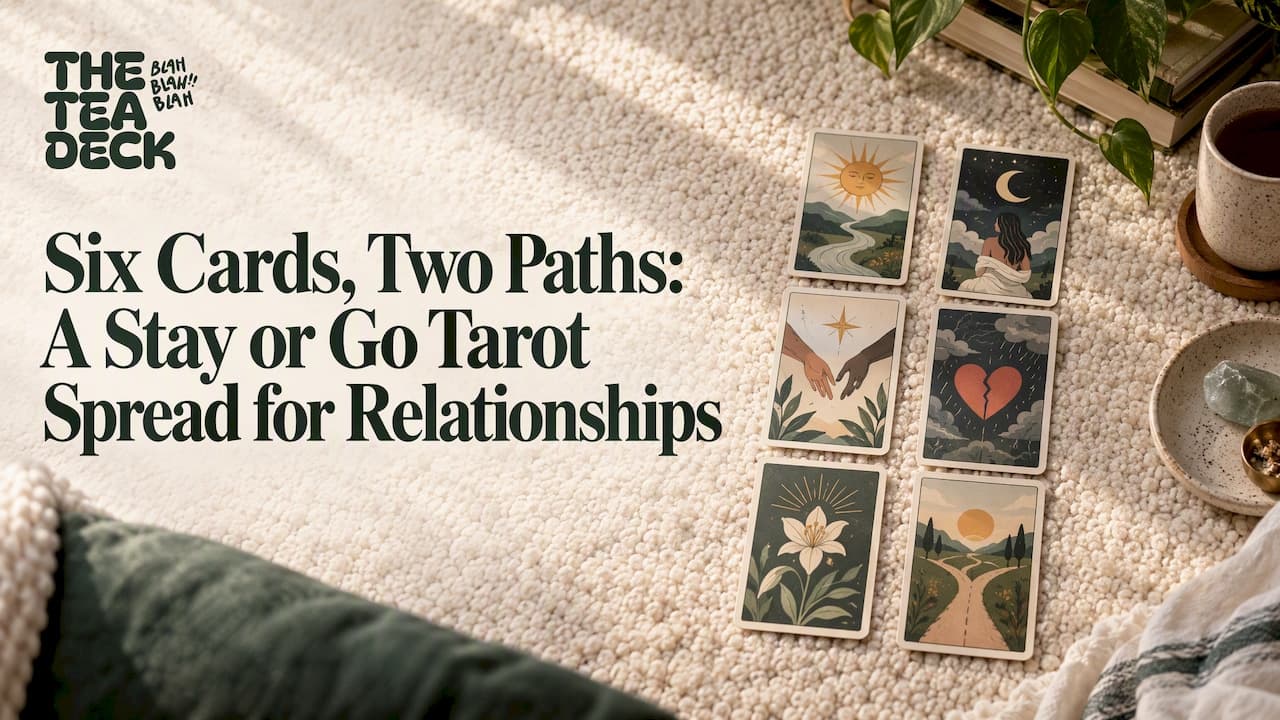
This six-card layout is a common relationship crossroads pattern, and you can lay it out quickly. Shuffle while holding your question in mind, then place the cards in two rows of three, left to right.
Positions:
- Card 1, current state: where the relationship stands right now.
- Card 2, why stay: what keeps you here or what is genuinely worth keeping.
- Card 3, why go: what pulls you toward leaving.
- Card 4, outcome if staying: how you may feel if you remain.
- Card 5, outcome if leaving: how you may feel if you walk away.
- Card 6, overall guidance: the angle to keep in mind as you decide.
How to read it:
- Turn over card 1 first and read it before touching anything else.
- Reveal cards 2 and 3 together, since they are meant to be compared.
- Reveal cards 4 and 5 together for the same reason.
- Finish with card 6 as the summary.
- If one card is unclear, pull a single clarifier and place it beside the confusing card.
Treat upright and reversed cards as you prefer, but stay consistent through the whole reading. Speak your question aloud before you shuffle. Two prompts that work well: "Show me what I need to see about staying in this relationship," and "Show me what I need to see about leaving it."
Interpreting the spread: positions, card meanings, and combinations
Read each card for what it says about that position, not as a verdict on the whole relationship. A few shorthand meanings help:
- Major Arcana cards signal weight. The Lovers points to values and a real choice, the Tower to sudden disruption, Temperance to patience and balance, and Death to an ending that makes room for change.
- Cups speak to feelings and emotional connection. Swords point to thoughts, honesty, and conflict. Wands show energy, desire, and momentum. Pentacles cover stability, effort, and practical life.
- Court cards often describe a person or a mindset. A Page may signal a beginner's openness, a Knight a push toward action, a Queen emotional maturity, and a King authority or control.
The real information sits in how positions interact. Warm Cups in "why stay" next to a Tower in "why go" suggests real affection with a serious structural problem. Two Swords cards in both columns point to unspoken tension that belongs in a conversation, not a shuffle.
For reversed or ambiguous pulls, use simple weighing rules. Give more weight to themes that repeat across the spread. Favor the two outcome cards (4 and 5) over the reasons, since they describe where each road leads. When a card still feels murky, read it as the same energy turned inward or delayed, then move on.
Pro Tip: Photograph the spread before you read it. Looking at the whole layout later often shows a pattern you missed while focused on individual cards.
How to frame your question and prepare for a reading
A good question is neutral. A leading question hands the cards the answer you already want.
- Do this: "What do I need to understand about staying in this relationship?"
- Avoid this: "Why won't they change?"
- Do this: "What might leaving look like for me?"
- Avoid this: "Will they come back if I leave?"
Before you shuffle, take a minute to settle. Breathe slowly three times, name the emotion you feel most strongly (anger, hope, dread), and set a simple intention, such as "I want to see this clearly." Naming a feeling keeps it from quietly steering your interpretation.
Pull a clarifier only when a single card is genuinely confusing, and pull one at a time. Drawing card after card because you dislike an answer adds noise, not clarity. If the same message appears twice, you have already been told.

What to do after the reading: applying insights without outsourcing your judgment
Turn the reading into small experiments you can observe in real life. Journal first, then test.
- Write one line per position. If you are leaning toward staying, note what you will watch for in the coming days. If leaning toward leaving, list what you would need to prepare, such as logistics, support, and timing.
- Run a communication experiment. Pick the friction point the cards raised and say it once, plainly: "When this happens, I feel this, and I need that." Notice how the response lands.
- Run a boundary experiment. Choose one small limit and hold it consistently. Evidence of how it is received tells you more than any card.
- Bring in another voice. Talk with a trusted friend, a therapist, or a private reader if you feel stuck. Our Be Your Own Cup page covers building personal insight over time.
Research and perspective: tarot as a reflective decision tool
Small qualitative studies suggest why people reach for tarot at a crossroads. A 2026 qualitative study found participants used tarot for self-reflection, decision-making, validation, and emotional reassurance. A separate interpretative analysis of psychology students described tarot being used in romantic dilemmas to reinforce evaluations. Both describe subjective experience, not proof of effectiveness, so treat tarot as a complement to your judgment and to professional help.
Where a spread earns its place in the decision
Here is my stance: the most useful card in this spread is rarely the one that predicts. It is the one that makes you say something out loud you had been avoiding. I use this layout when someone arrives at a relationship crossroads, and the "why go" card tends to name what they already knew. One person saw it in a pull, then chose a small step: a direct conversation instead of continued silent debate. Use the cards as a mirror, never as a boss.
— THE
One-on-one clarity with private readings from The Tea Deck
If you would rather hear it from someone else, we offer private tarot readings built around your own stay-or-go question, with no appointment to sit through and no one watching you react. Our readings are built around the question you actually have.

- Concise interpretations that get to the point about feelings, intentions, and direction.
- Room to follow up with a specific question about your situation.
- A discreet, private format delivered straight to you.
You can see how it works on our process page, then request a private reading when you are ready.
FAQ
Can a stay or go tarot reading tell me what to do?
No. A stay-or-go reading offers perspectives to examine, such as motivations, possible emotional outcomes, and friction points. The decision remains yours, and the cards work best as a prompt for reflection.
How many cards should a stay or go tarot spread use?
Six is a common choice: current state, why stay, why go, outcome if staying, outcome if leaving, and overall guidance. It is small enough to read in one sitting and covers both options evenly.
Should I pull more cards if I do not like the answer?
Pull a clarifier only when a specific card is unclear, and keep it to one. Extra pulls usually add noise. Repeated themes across the spread are a stronger signal than any single new card.
Is tarot a substitute for therapy when deciding about a relationship?
No. Research on tarot describes subjective experiences such as reflection and reassurance, not clinical outcomes. For serious or unsafe situations, a therapist or other qualified professional is the right support.
Sources
- Researchgate
- [Pengalaman dan Pemaknaan Mahasiswa Psikologi dalam Menggunakan Jasa Tarot | SOSMANIORA: Jurnal Ilmu Sosial dan Humaniora](https://www.journal.literasisains.id/index.php/sosmaniora/article/view/7723)