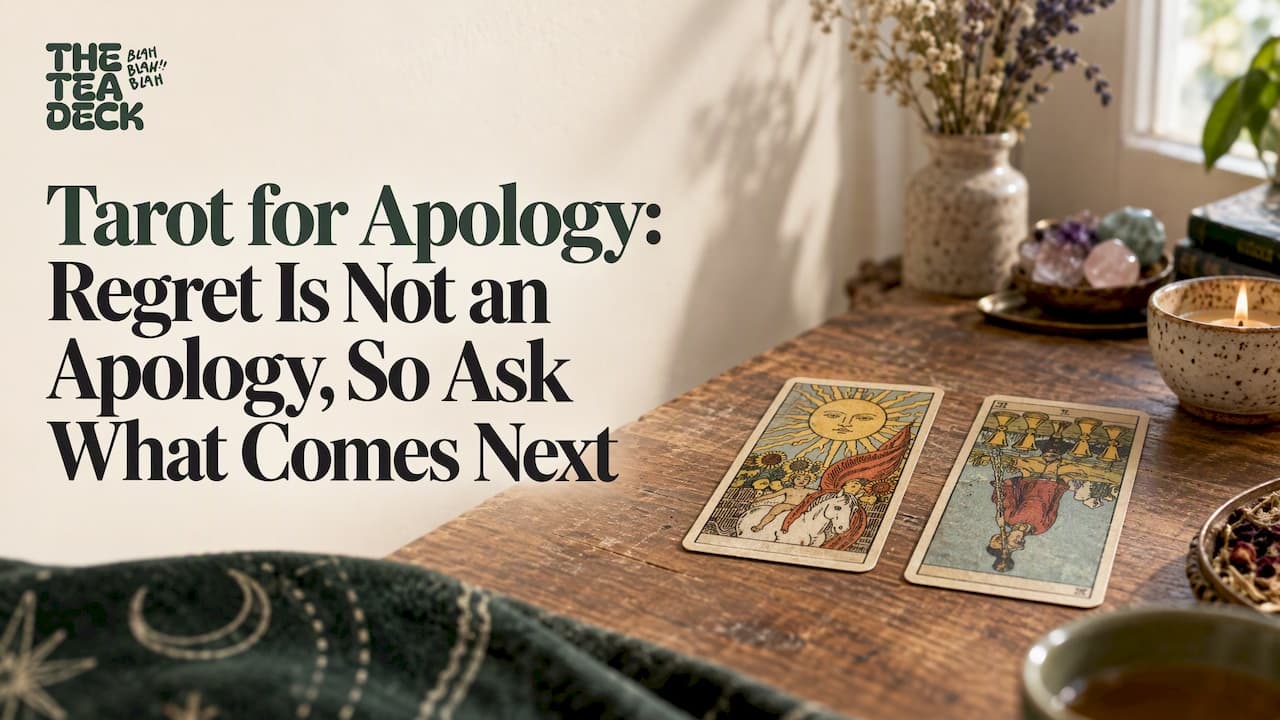
The cards most often read for apology are Judgement, the Five of Cups, Justice, the Two of Cups or The Lovers, and the Ace of Swords, with other cards adding context around timing and memory. None of these cards guarantees that an apology is coming. Orientation, surrounding cards, and spread position shift the meaning from "they feel sorry" to "they're ready to act," which is why context matters more than any single card. The next section breaks down each card on its own.
TL;DR:
- Pair Judgement with Two of Cups for accountability and reconnection, or Ace of Swords with Justice for a direct, spoken acknowledgment.
- A card in their feelings slot describes emotion, while likely actions or near future suggests movement; an obstacle position can reveal what blocks outreach.
- A neutral prompt about what is standing between you and an apology gives more room for guidance than a yes or no prediction.
- Reversed Judgement can suggest stalling, while reversed Five of Cups may show someone moving on; neither position confirms they will reach out.
- Use a three card spread for their feelings, your feelings, and likely outcome; add obstacle and timing positions for a fuller reading.
Table of Contents
- Cards commonly read as apology or remorse
- Which card combinations and positions strengthen the signal
- How to ask tarot about apology: phrasing and spreads
- Why orientation and timing matter more than the card itself
- What a thoughtful apology reading should and shouldn't do
- Getting a clear, private read on your apology question
- FAQ
- Sources
Cards commonly read as apology or remorse
These cards show up again and again in readings about regret, accountability, and reconciliation, and Courtney Weber's tarot tutorials discuss several cards in connection with apology questions.
- Judgement points to a reckoning: someone facing the consequences of their choices and deciding whether to make things right. It can point to a reckoning and accountability, though it does not guarantee that an apology is coming. Example: Judgement upright next to a card about the other person suggests they're actively weighing what they did.
- Five of Cups is the card of regret, often tied to a specific loss rather than a general bad mood. It can point to regret and remorse, though it does not guarantee that an apology is coming. Example: Five of Cups reversed in a "their feelings" position suggests lingering sadness without a clear plan to reach out.
- Justice is about taking ownership and facing things fairly. Upright, it suggests accountability, maybe even a formal or clearly stated acknowledgment. It can point to taking responsibility, though it does not guarantee that an apology is coming. Example: Justice upright paired with a communication card points toward a direct, spoken apology rather than a vague gesture.
- Two of Cups or The Lovers both speak to emotional connection and the desire to reconnect. Upright, Courtney Weber's 2026 tutorial notes The Lovers specifically can read as "they're sorry and they miss you." Interpretation depends on the spread and reader; reversed The Lovers can indicate avoidance. Example: The Lovers upright next to Six of Cups suggests they miss the relationship as it used to be.
- Ace of Swords represents a sudden burst of honesty, a conversation where the truth finally gets said. It can point to candid conversation, but does not guarantee that an apology will follow. Example: Ace of Swords in a near-future position suggests an honest talk is coming, whether or not it includes the word "sorry."
- Six of Cups may add context to a reading, depending on the spread and reader.
- Wheel of Fortune may add context to a reading, depending on the spread and reader.
Which card combinations and positions strengthen the signal
A single card rarely tells the full story. Pairing cards and watching where they land in a spread sharpens the read, and Thursday Tarot Tutorials frame these cards as showing what kind of apology might be possible rather than a flat yes or no.
- Judgement + Two of Cups combines reckoning with reconnection, a strong pairing for a genuine, relationship-focused apology.
- Five of Cups + Six of Cups combines regret with nostalgia, suggesting sorrow tied to missing how things used to be.
- Ace of Swords + Justice combines honesty with accountability, often pointing to a direct, spoken acknowledgment rather than a vague gesture.
- Wheel of Fortune + a court card combines timing with a person, suggesting someone specific may step forward as circumstances shift.
Position matters as much as pairing. A card in a "their feelings" slot describes emotion, not action. The same card in "their likely actions" or "near future" suggests movement, while a card in an "obstacle" position shows what's standing in the way. A simple three-card spread (their feelings, your feelings, likely outcome) handles most apology questions. A five-card version adds obstacle and timing positions for more nuance: their feelings, their likely actions, obstacle, timing, and advice for you.
How to ask tarot about apology: phrasing and spreads
How you phrase the question shapes the reading. A leading question like "Why haven't they apologized yet?" assumes a conclusion. A neutral one, like "What's standing between us and an apology?" leaves room for the cards to answer honestly.
- Prefer open phrasing over yes-or-no questions: "What is their current state of mind regarding our conflict?" works better than "Will they apologize?"
- For timing, try: "What does the near future look like for this situation?"
- For guidance, try: "What would help move this toward resolution?"
Three spread options cover most apology questions. A three-card past, present, future spread shows how the conflict started, where it stands now, and where it's headed. A five-card apology spread (their feelings, their likely actions, obstacle, timing, advice) gives a fuller picture. A single-card quick check works when you just need a gut-check before deciding whether to reach out yourself.
When booking a private reading, a specific prompt gets a sharper answer. "What would help them apologize?" tends to produce more useful guidance than "Will they apologize?" because it points the reading toward action instead of prediction.
Why orientation and timing matter more than the card itself
Upright and reversed meanings aren't opposites so much as different stages of the same feeling. Judgement upright suggests someone is actively facing their actions; reversed, they're stalling. The Five of Cups upright leans into fresh regret; reversed, it often shows someone has already started to move on, with or without repairing things.
Timing cards do real work here. The Wheel of Fortune in a near-future position suggests change is close. A court card in that same slot can mean a specific person is about to act. A card sitting in an "obstacle" position, even a hopeful one like the Two of Cups, might mean the feeling is there but something practical, like pride or distance, is in the way.
A card can show "they feel sorry" without showing "they will apologize." The Five of Cups can confirm regret while leaving the question of outreach completely open. When that happens, the next useful question isn't "will they," but "what's blocking them," which points straight back to an obstacle-position card.

What a thoughtful apology reading should and shouldn't do

A reading about someone else's remorse works best as a tool for your own clarity, not a way to script their next move. The cards can validate what you're sensing or challenge an assumption you've been carrying, but they can't force an outcome, and treating a spread as a guarantee usually backfires emotionally.
After a reading that touches on regret or reconciliation, a few minutes of journaling about what came up, paired with a decision about timing before reaching out, tends to help more than replaying the cards for a different answer. A focused, private interpretation can be useful here, especially when the question is specific and the stakes feel personal.
— THE
Getting a clear, private read on your apology question
When a reading touches something as personal as whether someone's sorry, a quick, private answer beats guessing alone or asking around for secondhand opinions. We built our private tarot readings at The Tea Deck around exactly that: concise, specific interpretations delivered directly to you, without an in-person session.

To get the clearest answer, come with a specific question, something closer to "What would help them apologize?" than a general "What's going on with them?"
- We deliver readings digitally, so there's no waiting room or small talk, just your question and a direct interpretation.
- Readings can offer a focused answer without committing to an ongoing arrangement.
- You can see how the process works, from question to delivery, on our process page.
If you want a straight answer on where things stand, book a private reading and ask the question you've been sitting with.
FAQ
What tarot cards represent an apology?
The cards most commonly read for apology are Judgement, the Five of Cups, Justice, the Two of Cups or The Lovers, and the Ace of Swords, according to Courtney Weber's tarot tutorials. Each one highlights a different angle, from accountability to emotional reconnection, and none guarantees the apology will actually happen.
What tarot card represents forgiveness?
The Two of Cups can point to emotional reconnection and compromise. Judgement can also appear in forgiveness readings when it points to a mutual reckoning rather than one person's regret alone.
What is a symbol of apology in tarot?
The Five of Cups can point to regret and remorse. The Lovers upright can also read as an apology signal, specifically "they're sorry and they miss you," according to Tarot Tutorials.
How do I phrase a tarot question about apology?
Open, non-leading questions tend to give clearer answers than yes-or-no ones. Try "What's standing between us and an apology?" or "What would help them apologize?" instead of "Will they apologize?"
Can tarot guarantee someone will apologize?
No single card or spread can guarantee an outcome like that. Tarot readings on apology tend to show tendencies, feelings, and possible timing rather than a fixed prediction, which is why context and follow-up questions matter.
Sources
- Tarot Tutorials: What Tarot Cards Represent An Apology?
- Tarot Tutorials: What Tarot Cards Represent An Apology?