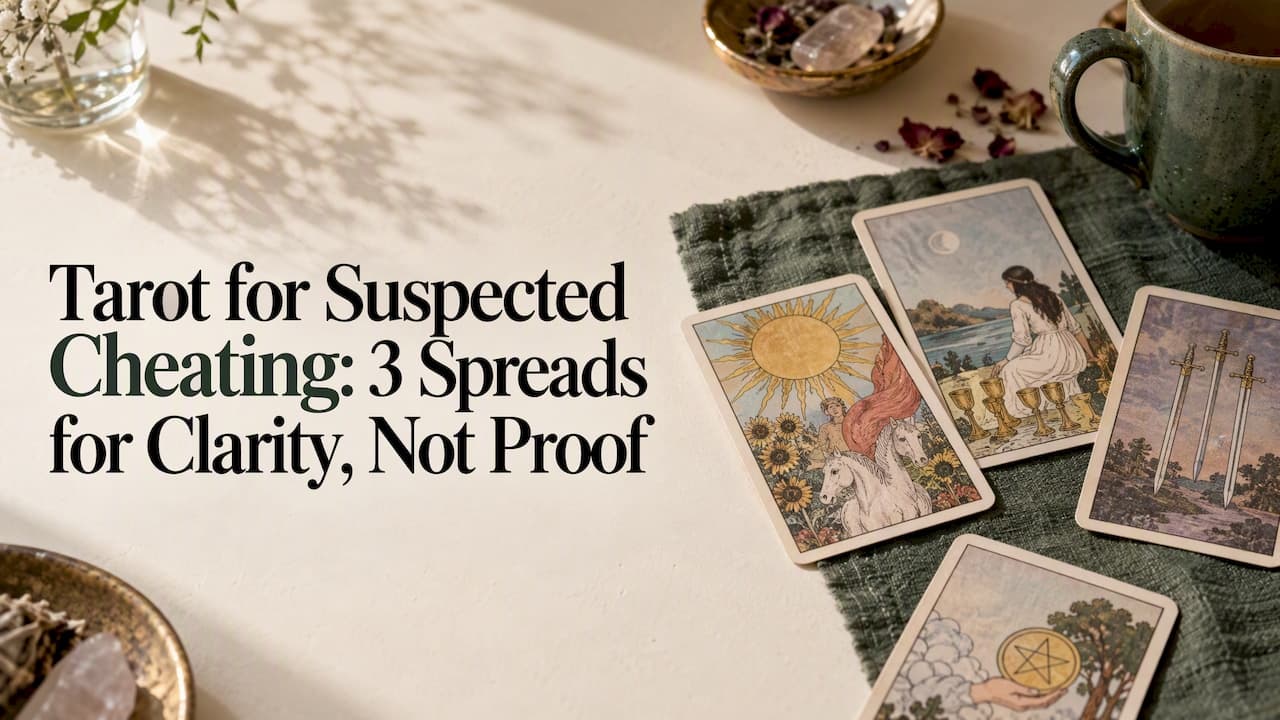
Tarot cannot prove infidelity, and no honest reader will tell you otherwise. What a reading can do is surface the secrecy, distance, or unease you already sense but have not named, and show you where your own doubts might be clouding the picture. A clear, consistent pattern across cards usually points to an emotional truth worth addressing, while a muddy or contradictory spread often means you need more information before drawing conclusions. Either way, the cards are a starting point for reflection, not a verdict, and the spreads below will help you use them that way.
TL;DR:
- Read cards by position and combination: the Seven of Swords in hidden influences suggests concealment, while in your fears it may reflect anxiety.
- Use a spread with five positions to examine hidden influences, both partners’ emotional states, and an honest next step; draw three cards for quick grounding.
- A 2026 study found predictive tarot prompts averaged 1.58 in affirmation strength, versus 0.82 for introspective prompts, so ask what you need to understand.
- Record cards and first impressions, wait 24 to 72 hours before acting, then discuss feelings and concrete evidence rather than treating cards as proof.
- Treat AI interpretations as a second opinion, not a tiebreaker, because they can reinforce existing bias rather than challenge it.
Table of Contents
- Cards and symbols readers commonly associate with cheating or secrecy
- Practical spreads to use when you suspect infidelity
- How to interpret results responsibly and avoid confirmation bias
- Research-backed view: tarot as projective meaning-making and AI's role in interpretations
- How I approach questions about cheating in private readings
- The Tea Deck: private tarot readings for relationship clarity
- FAQ
- Sources
Cards and symbols readers commonly associate with cheating or secrecy
Certain cards show up again and again when people ask about a partner's faithfulness, though tarot cannot reliably confirm an external event like an affair. Practitioner consensus across guides and community discussions tends to link a handful of cards to secrecy, jealousy, or betrayal, and recognizing them helps you read a spread with more nuance than panic.
- The Moon: signals confusion, hidden information, or a situation that is not what it appears to be.
- Seven of Swords: often read as stealth or someone acting behind another's back, sometimes literally sneaking around.
- Three of Swords: points to heartbreak, betrayal, or words that wound, frequently appearing when grief is already present.
- The Devil: suggests temptation, entanglement, or a relationship built on dependency rather than honesty.
- Five of Swords: a conflict where someone wins at another's expense, sometimes read as a partner prioritizing their own desires.
- Page of Swords: can indicate gossip, surveillance, or someone watching and gathering information, including you.
- Two of Pentacles: juggling, often interpreted as a partner splitting attention between you and someone or something else.
- Court cards (especially Knights or Queens/Kings of a suit outside the reading's usual pattern): frequently read as a third party entering the dynamic.
Position matters as much as the card itself. The Seven of Swords landing in a "hidden influences" slot next to your partner's position reads differently than the same card appearing in a "your fears" slot. The first suggests something concealed in the relationship; the second may simply reflect your own anxiety. Combinations tell the fuller story: The Moon paired with the Two of Pentacles might describe a partner stretched thin and withholding details, not necessarily betrayal. Treat every card as a description of a dynamic or feeling, never as a factual report on what someone did behind closed doors.
Practical spreads to use when you suspect infidelity
A good spread gives structure to a messy emotional question without pretending to deliver proof. These three work well depending on how much time and clarity you want.
- Five-card truth and hidden influences spread: lay cards for "what you see," "what's hidden," "your partner's emotional state," "your emotional state," and "the most honest next step." Ask what each position reveals about the relationship's current dynamic, not about a specific act.
- Four-card communication and intent spread: positions for "your partner's willingness to be honest," "what's blocking honesty," "what you need to feel safe," and "a realistic outcome if you speak up." This spread works best when your real question is whether the relationship can tolerate a direct conversation.
- Three-card clarity spread: pull one card each for "what you need to know right now," "what you can do about it," and "the likely next step." This is the fastest option when you want grounding rather than depth.
Before pulling, take a few minutes to breathe, set your intention in neutral language, and write down the question you are actually asking rather than the fear driving it. Record your draw and your first gut interpretation before researching card meanings, since your initial reaction often tells you as much as the cards do. Journaling the spread, date, and your emotional state at the time also makes it easier to notice patterns if you return to the same question later.
Pro Tip: Give at least a few days between repeat readings on the same question. Pulling cards daily to chase certainty tends to produce noise, not clarity, and can turn a reflective practice into an obsessive one.

How to interpret results responsibly and avoid confirmation bias
A card means little without context. Before you decide The Devil "confirms" an affair, match it against what you actually know: recent behavior changes, specific conversations, concrete inconsistencies. Cards describe emotional states and dynamics far more reliably than they describe discrete actions, so separate internal-state cards (The Moon, Three of Swords) from action-oriented ones (Seven of Swords, Knights) when you interpret a spread, and notice how they interact rather than reading each in isolation.
How you phrase the question changes what you get out of it. A 2026 study on AI-generated tarot interpretations found that predictive questions, like asking directly whether a partner is cheating, produced interpretations that affirmed the premise far more strongly than introspective questions did.
The study measured affirmation strength on a scale and found predictive questions averaged 1.58 compared to 0.82 for introspective ones, meaning the way you ask shapes the answer you receive. That gap holds whether you are reading for yourself or using an AI tool to cross-check a spread, so lean toward prompts like "What do I need to understand about my partner's emotional state?" rather than "Is my partner cheating on me?"
After a reading, resist the urge to act immediately:
- Write down the cards, positions, and your interpretation while it's fresh.
- Sit with the reading for 24 to 72 hours before deciding what it means.
- Plan a calm conversation focused on your feelings and any concrete evidence, not accusations drawn from a card.
- Consider therapy, individually or as a couple, if the uncertainty is affecting your well-being regardless of what the cards show.
Research-backed view: tarot as projective meaning-making and AI's role in interpretations
Academic literature frames tarot as a projective technique, closer in function to an inkblot test than a lie detector. A counseling-focused review, Divining the Self, describes tarot as useful for generating insight and hypotheses in a counseling setting, while cautioning against treating it as a diagnostic tool for facts about the external world.
Tarot functions as an expressive, projective technique that can support introspection and emotional processing, but it carries real limits when used to assert facts about events or other people's behavior.
That caution extends to newer tools. Qualitative research presented at CHI 2026 found that people increasingly use AI alongside traditional tarot to widen their interpretive options, though AI output can just as easily confirm an existing bias as challenge it. Why readings feel so convincing in the first place comes down to ordinary psychology: confirmation bias makes ambiguous symbols fit whatever we already fear, and pattern perception fills gaps with meaning that was not necessarily there, a dynamic Forbes has described in coverage of tarot's psychological effects.
A few habits keep the practice honest:
- Favor introspective prompts over predictive ones to reduce artificially inflated "confirmation."
- Use an AI interpretation, if you try one, as a second opinion to compare against your own reading, not as a tiebreaker.
- Treat every resonant card as information about your emotional state first, and evidence about someone else's actions only when it lines up with real-world facts.
How I approach questions about cheating in private readings
When someone brings a cheating question into a reading, the goal is clarity, not confirmation. We phrase prompts around feelings, patterns, and needs rather than yes-or-no accusations, because that framing produces answers people can actually act on. A concise, private reading works well here specifically because it lets you sit with mixed signals without an audience. Self-pulled spreads are a strong first step; a paid reading makes sense when you want a second, less emotionally entangled perspective on the same cards.
— THE
The Tea Deck: private tarot readings for relationship clarity
Suspecting infidelity is isolating, and most people do not want to process it in a public forum or a crowded group chat. We built The Tea Deck around that need: private, concise readings delivered directly to you, with no in-person appointment and no small talk, just a focused answer to the question you actually asked.

Readings start with affordable options, and you can ask specific, pointed questions about your situation rather than settling for a generic spread. Our process page walks through how a reading works and what to expect before you book, and if you'd rather build your own practice first, Be Your Own Cup offers tools for self-directed reflection that pair well with a professional reading when you want a second set of eyes.
FAQ
What tarot card signifies the end of a relationship?
The Three of Swords and the Ten of Swords are commonly read as endings marked by pain or finality, while the Death card more broadly signals a transition rather than literal relationship termination. Context and surrounding cards determine whether an ending reading points to a breakup or simply a shift in the relationship's dynamic.
What is a good quote about cheating?
Tarot guides and relationship resources tend to focus on practical framing rather than quotable lines, so there is no single widely cited quote to point to here. A more useful approach is reading the Three of Swords or Seven of Swords alongside your own notes on recent behavior.
How do you get tarot cards to jump out?
Some readers shuffle loosely enough that a card physically falls or juts out from the deck, and traditionally this card is read as an urgent message worth addressing before the rest of the spread. It is a shuffling technique, not a different form of tarot, and the card still gets interpreted using the same symbolic meanings as any other draw.
How truthful is tarot?
Tarot is best understood as a projective technique that supports introspection, similar to how a counselor might use an open-ended prompt, rather than a method for confirming facts about events or other people's actions, as research on tarot in counseling settings describes. Its accuracy about your emotional state tends to feel stronger than its accuracy about external, verifiable events.
Sources
- Interpretations of Tarot Card Spreads by AI: Predictive Versus Introspective Questions | Frontiers in Computing and Intelligent Systems
- Interpretive cultures: resonance, randomness, and negotiated meaning for AI-assisted tarot divination | CHI 2026
- Divining the Self: Applying tarot as a projective technique in counseling
- Why tarot readings can help manifest your reality (Forbes)