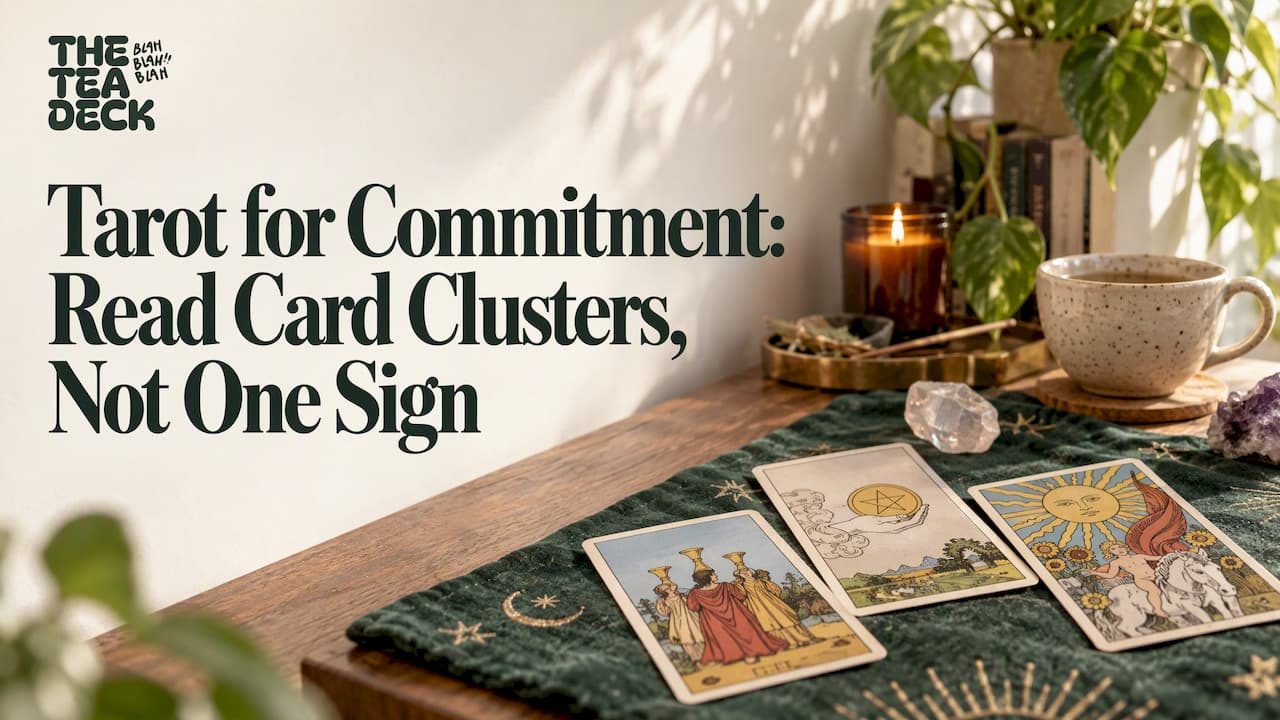
Tarot can show you meaningful patterns in feelings, intentions, and the way a relationship is moving, but it works best as a reflective tool, not a literal forecast. The strongest commitment signals come from clusters: Major Arcana or structure cards like the Emperor and Pentacles, backed by supportive Cups. One happy card proves little. A focused question and a clear spread turn symbols into advice.
TL;DR:
- A cluster of Pentacles or Major Arcana cards beside supportive Cups suggests follow through more than one romantic card alone.
- Use a five card spread for current state, intent, obstacle, likely trajectory, and your next step; pull only one clarifier for an unclear position.
- Ask what would help them decide to commit within six months, not whether they will; wait before repeating a reading.
- Read timing cards as suggestions, and distinguish dedication from constraints: shared investments can keep a couple together even when the desire to stay is weak.
Table of Contents
- 1. Which cards signal commitment or loyalty?
- 2. How do you set up a commitment-focused spread?
- 3. How do experienced readers weigh clusters and reversals?
- 4. Does a card tell you when, and what kind of commitment?
- 5. How should you ask about commitment?
- 6. What does research say about tarot and commitment questions?
- 7. Where we stand on commitment readings
- 8. Get a private commitment reading from us
- FAQ
- Sources
1. Which cards signal commitment or loyalty?
Readers tend to treat a handful of cards as commitment markers. The logic comes from each card's archetype and suit, so it helps to know why a card earns its reputation, not just its name.
- The Hierophant: tradition, shared values, and formal commitment such as engagement or marriage.
- The Emperor: structure, stability, and a partner who takes responsibility and makes plans.
- Justice: long-term accountability, fairness, and decisions that carry consequences.
- Four of Wands: a public milestone, celebration, and a stable home base.
- Two of Cups: a mutual bond where both people show up equally.
- Ten of Cups: emotional fulfillment and a shared future, often with family in the picture.
- Eight of Pentacles: steady effort, someone putting in the work to build something lasting.
Suit matters for how you weigh these. Cups describe feeling, and feeling can be sincere but short-lived. Pentacles and the Major Arcana point toward plans, intent, and real-world follow-through. Always read a card against its neighbors and its position, never alone.
Pro Tip: When a Cups card looks promising, look for a Pentacles or Major Arcana card nearby. Feeling plus action is a stronger story than feeling alone.
2. How do you set up a commitment-focused spread?
A good spread asks specific questions of each position, so the cards answer something useful. Here is a five-card "situationship" layout you can run at home:
- Current state: where the relationship actually stands today.
- Their intent: what the other person wants, as far as the cards can show.
- The block: what is holding commitment back.
- Likely trajectory: where things head if nothing changes.
- Your advice: one concrete step you can take.
Prefer something lighter? A three-card clarity spread uses past signal, present readiness, and near-future action. For practical decisions like moving in together, try a timeline-plus-constraints variant: three cards for the coming months, plus one card for the obstacle that could slow things down.
To adapt any general relationship spread, rename the positions around commitment. Swap "how they feel" for "what they are ready to do." When a card is unclear, pull one clarifier:
- Draw it only for the position that confuses you.
- Stop after one clarifier, because extra pulls tend to muddy the answer.
- Write down your first impression before you look up meanings.
3. How do experienced readers weigh clusters and reversals?
Experienced readers look for agreement. Several cards across different suits and positions pointing the same way form a strong signal. A lone Two of Cups beside four cards of conflict does not. Background practice among readers also gives extra weight to a Four of Wands paired with structure cards like the Emperor or Pentacles over a single Cups card.
Some cards modify the whole reading:
- The Moon: uncertainty, mixed messages, or something not yet visible.
- The Devil: attachment or codependency that can look like commitment but feels more like a grip.
- A Swords majority: hesitation, overthinking, or conflict between the two of you.
Court cards deserve a second look too. If the same court card or rank shows up in the "intent" and "outcome" positions, the reading is consistent. If intent says one thing and outcome says another, the gap itself is your answer: words and actions may not match.
Reversed cards often show a block, a delay, or energy turned inward rather than a flat "no."
Pro Tip: Count how many cards agree before you decide what the reading says. Agreement beats any single dramatic card.

4. Does a card tell you when, and what kind of commitment?
Timing is the weakest thing tarot offers, and it helps to separate two kinds of commitment. Relationship research distinguishes dedication from constraints: dedication is the personal desire to keep the relationship going, while constraints are the investments that make leaving harder, like a shared lease or shared friends. Constraints can keep a couple together even when dedication is thin.
Tarot often mirrors this split:
- Cups, the Lovers, and the Two of Cups tend to speak to dedication.
- Pentacles, Swords, and the Hierophant often show constraints, obligations, or visible obstacles.
- Timing cards are suggestions, so ask a clarifier that names a timeframe rather than assuming a card means "this month."
A card showing readiness does not promise an engagement ring by spring. Use it to see what kind of bond you are dealing with.
5. How should you ask about commitment?
The wording of your question shapes the answer. "Will he commit?" invites a vague yes or no and tends to produce anxious overreading. A better question asks what you can learn or do:
- "What would help them decide to commit in the next six months?"
- "What is standing between us and a clearer next step?"
- "What do I need to understand about my own readiness?"
Avoid loaded yes/no questions and anything that asks the cards to lock in a fixed outcome. Before you pull cards, check that you feel calm enough to hear a mixed answer, and decide how you plan to use the insight, whether that is a conversation or a decision of your own. If the reading raises more questions than it answers, wait a bit and run a follow-up instead of re-pulling the same night.
Pro Tip: Write your question down first. If it contains "will he" or "why won't she," rewrite it to start with "what" or "how."
6. What does research say about tarot and commitment questions?
Treating tarot as a window into your own thinking has academic support. A James Madison University project describes tarot as a projective technique: people project unconscious thoughts, anxieties, and desires onto symbolic imagery, which helps with self-reflection. A related paper, Divining the Self, finds that when tarot is used expressively in counseling, it can complement therapeutic work, provided it is not used diagnostically.
Tarot can be applied as a projective technique when used expressively rather than diagnostically, inviting client-generated meaning and reflection.
Jungian readings add that tarot images work as archetypal symbols that help people narrate past, present, and future at once. What that means for you:
- Use tarot to clarify your feelings and options.
- Treat "will they commit?" answers as input to a decision, not a certainty.
- Expect the most value when you reflect on why a card resonates.
7. Where we stand on commitment readings
Dramatic predictions make for good screenshots and poor decisions. We favor short, clarity-first readings that name the pattern, point to what is blocking commitment, and end on a practical next step. That is how we run our private readings: you ask a specific question, and you get a focused answer delivered privately, without sitting across from a stranger. A reading should leave you clearer, not more anxious.
— THE
8. Get a private commitment reading from us
If you would rather have a reading done for you, we offer private tarot readings built around relationship questions, with concise, targeted answers. Current prices are on our site. Book a private reading and tell us what you want to understand.

- Bring one specific question about commitment.
- Share the context that matters: how long, what has been said, what feels unclear.
- Check how our process works before you start.
FAQ
What tarot card means loyalty?
The Hierophant, the Emperor, and the Four of Pentacles are commonly read as loyalty, since they point to tradition, stability, and holding steady. The Two of Cups adds mutual devotion. Read them alongside neighboring cards for context.
Which tarot cards indicate love?
The Lovers, the Two of Cups, the Ten of Cups, and the Empress are the usual love cards. Cups cards generally describe emotion, while the Lovers also speak to choice. A cluster of these is a stronger signal than any one.
Which tarot card represents temptation?
The Devil is the classic temptation card, tied to attachment, desire, and feeling stuck. Paired with Swords or the Moon, it can hint at unhealthy patterns or mixed motives.
What tarot card is good for manifesting?
The Magician is the manifesting card, about turning intention into action. The Star is often added for hope and long-range vision. Both work best when you pair the idea with a concrete step.